Cups Quarts Gallons Pints Explained
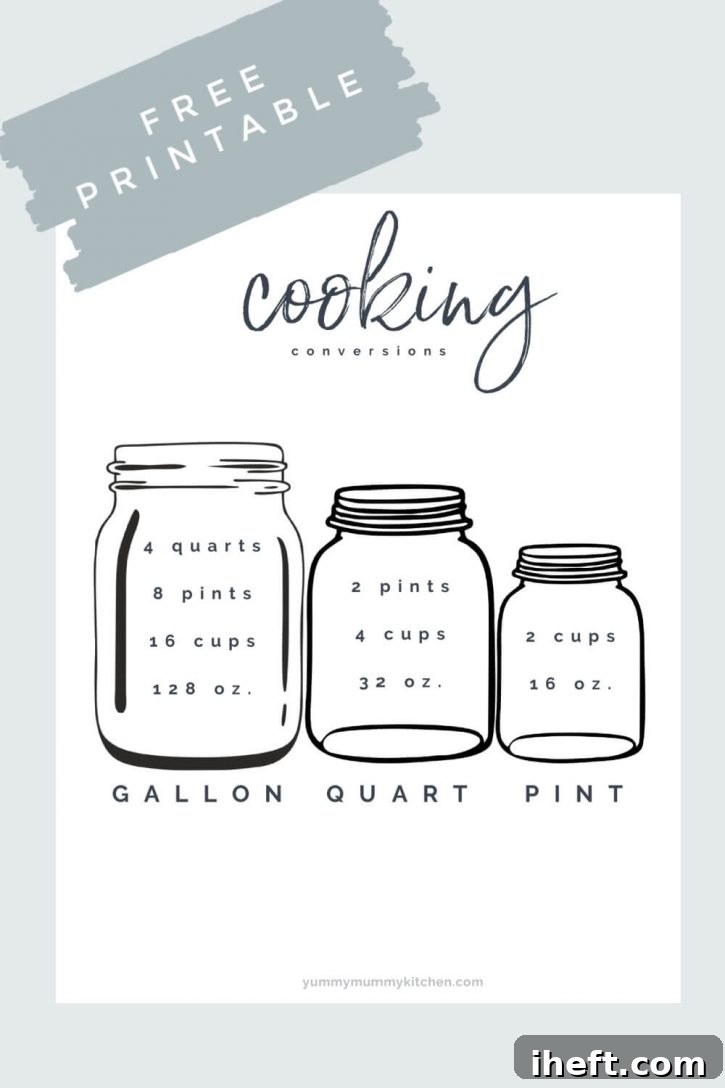
Navigating the world of liquid measurements can often feel like a complicated puzzle. How many cups in a gallon? How many quarts in a pint? These common kitchen queries can slow down even the most experienced home cooks. But fear not! We’ve meticulously crafted this comprehensive guide to demystify liquid measurement conversions, making your cooking and baking adventures smoother and more successful. Whether you’re whipping up a large batch of party punch or simply following a new recipe, understanding these fundamental conversions is key. To make things even easier, we offer two incredibly helpful free printable guides, including the famous Gallon Man, ready for you to reference at a moment’s notice.
It’s an interesting fact that the United States stands as one of only a handful of countries globally that does not predominantly use the metric system. Instead, we rely on the United States customary units for everything from culinary recipes to highway signage. While the metric system boasts a straightforward base-10 structure, U.S. measurements come with a variety of conversion factors that can, at times, feel arbitrary and confusing.
This inherent difference often leads to questions bubbling up in the kitchen: “How many cups are in a quart?” or “What’s the conversion from pints to gallons?” Such uncertainties can be particularly vexing when you’re trying to achieve precision in your cooking or baking. Our mission here is to illuminate the most essential liquid measurement conversions, ensuring that your culinary creations consistently turn out perfect, even if your specific measuring cups are missing or dirty.
It’s crucial to remember that these conversions primarily apply to liquids. Understanding the subtle yet significant distinctions between fluid ounces, dry ounces, and cups is foundational. For a deeper dive into these specifics, we recommend first exploring our guide on How Many Ounces in a Cup to build a solid measurement foundation.
The Gallon Man: Your Visual Guide to Liquid Conversions
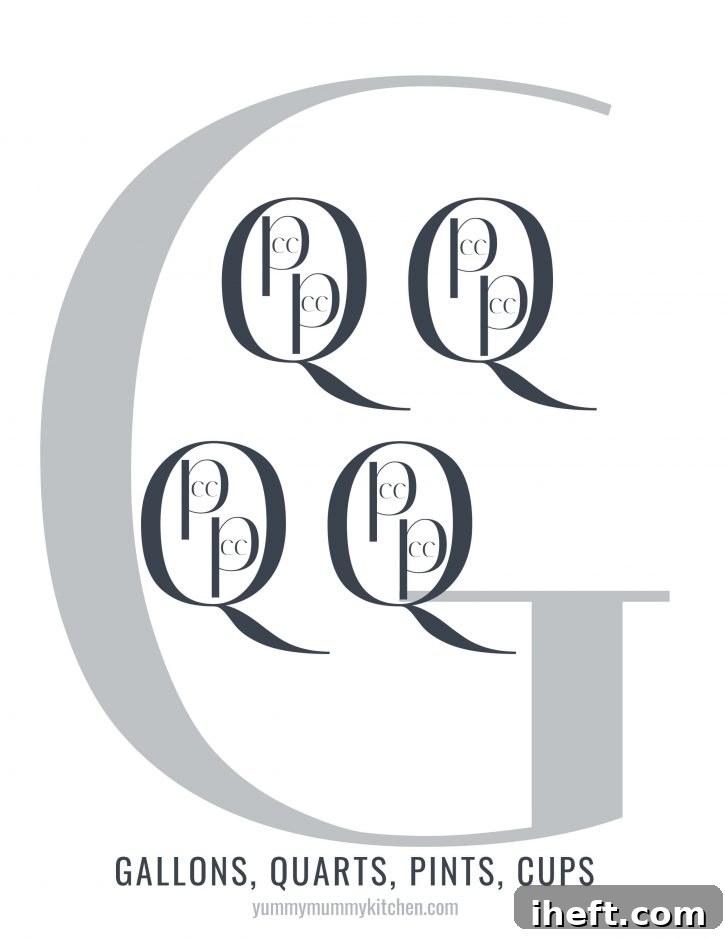
For generations, “The Gallon Man” has served as an incredibly effective and memorable mnemonic device for visualizing the relationships between gallons, quarts, pints, and cups. While its exact origin remains a charming mystery – a concept often taught in home economics classes years ago – its utility is undeniable. Though I’ve created this particular printable version, available for you to download and print, the core concept has helped countless students and cooks grasp these essential liquid measurement conversions with ease.
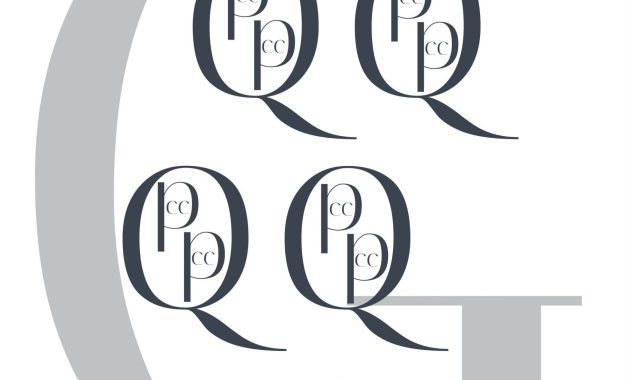
At first glance, the Gallon Man might appear a bit complex, but its design simplifies conversions remarkably. Imagine a large capital letter “G” representing one Gallon. Inside this “G,” you’ll find:
- Four large “Q”s, each symbolizing a Quart. This immediately tells you that a Gallon contains 4 Quarts.
- Within each “Q” (Quart), there are two “P”s, standing for Pints. Thus, a Quart holds 2 Pints.
- And finally, inside each “P” (Pint), you’ll discover two “C”s, representing Cups. This clearly illustrates that a Pint contains 2 Cups.
This ingenious visual aid allows you to quickly deduce how many of the smaller units fit into the larger ones. It’s perfect for those moments when you need a quick mental reference without having to do complex math. Keep this visual handy, and you’ll confidently tackle any recipe requiring precise liquid measurements.
CLICK HERE FOR THE FIRST PRINTABLE & HERE FOR THE SECOND
Understanding Gallon Conversions: The Big Picture
The gallon is the largest standard unit of liquid volume in the U.S. customary system, making it essential for large-scale cooking, preparing beverages for gatherings, or understanding larger commercial packaging. Knowing its internal breakdown helps immensely when scaling recipes or making bulk purchases.
How Many Cups in a Gallon?
There are exactly 16 cups in a gallon. This conversion is incredibly useful when you’re preparing beverages or recipes in large quantities, such as our favorite Strawberry Lemonade for a summer barbecue, or a big pot of soup for a crowd. If a recipe calls for several cups and you’re aiming to fill a gallon-sized dispenser, knowing this conversion means you can easily adjust ingredient amounts. For instance, if a recipe yields 4 cups and you want to make a full gallon, you’d simply multiply all ingredients by four. This is especially practical for party planning or meal prepping, ensuring you have enough to go around without over-measuring.
How Many Pints in a Gallon?
A gallon contains 8 pints. This conversion highlights the relationship between two commonly encountered units. Pints are frequently used for smaller dairy products, ice cream, or even some craft beverages. If you’re buying multiple pint-sized containers for a recipe that ultimately requires a gallon of liquid, you’ll know exactly how many pints to purchase. Conversely, if you need to scale down a gallon recipe to a pint serving, you’ll divide by eight, making recipe adjustments a breeze.
How Many Quarts in a Gallon?
You will find 4 quarts in a gallon. The term “quart” itself is derived from “quarter,” meaning one-fourth of a gallon. This makes it one of the most intuitive conversions. Quarts are a very common measurement for larger liquid items found in grocery stores, such as milk cartons, juice, and cooking broths. Understanding that a gallon is equivalent to four quarts allows for easy comparison shopping and efficient recipe scaling. For instance, if a recipe calls for a gallon of broth but you only have quart-sized containers, you’ll know you need four of them.
Demystifying Quarts: Your Go-To Mid-Size Measurement
The quart is a highly versatile and frequently used unit in the kitchen, bridging the gap between smaller pint and cup measurements and the larger gallon. Its convenience is reflected in how many everyday items are packaged in this size.
How Many Cups in a Quart?
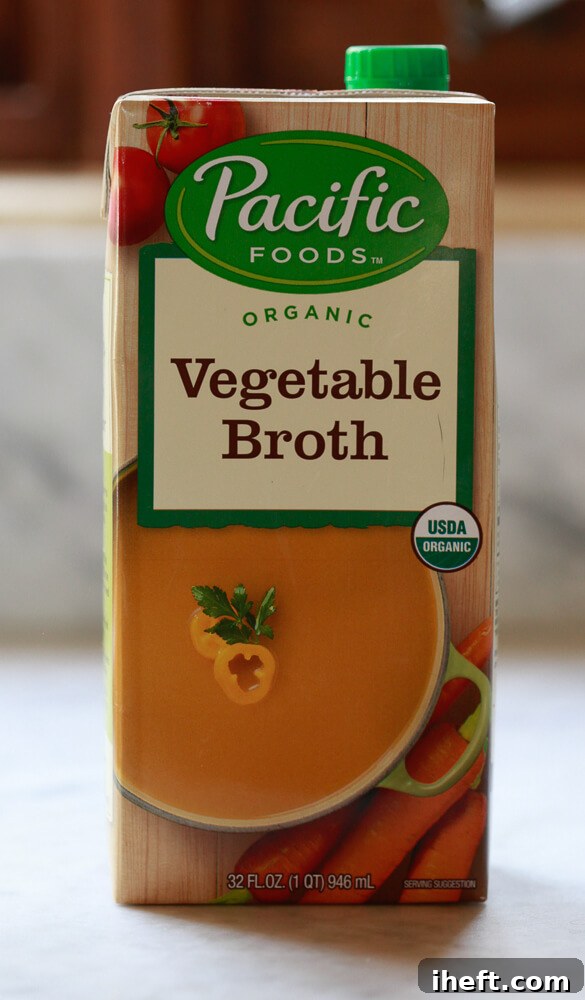
There are 4 cups in a quart. This is one of the most practical liquid measurement conversions for everyday cooking. Many standard liquid measuring cups have a 4-cup (or 1-quart) capacity, making it easy to measure directly. However, if you don’t have a quart-sized measuring cup available, you can simply use a 1-cup measure four times. This conversion is invaluable for recipes for soup, sauces, or punches that often specify a quart of liquid, or 32 fluid ounces. Common grocery store items like vegetable broth, as pictured above, frequently come in 32-ounce boxes, perfectly equaling one quart. When preparing a recipe that calls for this amount, I often find a large mason jar – which is typically 1 quart – to be a convenient measuring tool.
How Many Pints in a Quart?
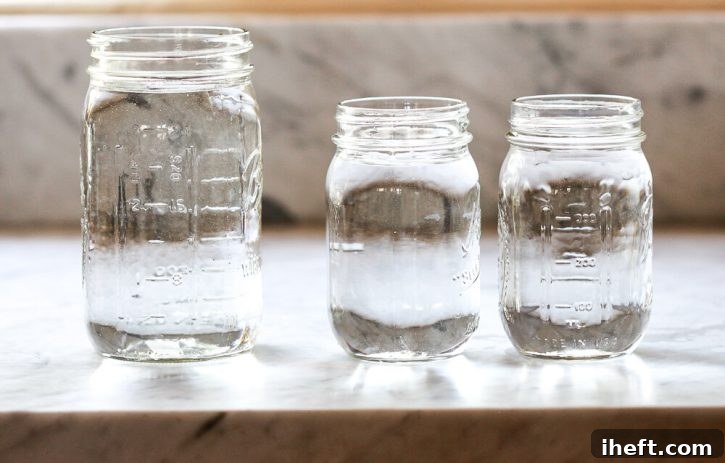
One quart contains two pints. Given that there are 32 fluid ounces in a quart, it logically follows that there are 16 fluid ounces in a pint. This conversion is particularly useful when dealing with products commonly sold in pint-sized containers. Think about those small containers of ice cream, heavy cream, or specialty coffee creamers – they are often sold in pints. You can also purchase a pint of milk, which is frequently the smallest available size. If a recipe specifies a pint, actively look for “pint” on the product label. If it’s not explicitly stated, simply look for a container indicating 16 fluid ounces. Furthermore, pint-sized canning jars are incredibly popular for home canning, but also serve as excellent drinking glasses or for preparing dishes like dressings and chia pudding. The image above beautifully illustrates this relationship, showing two smaller pint jars perfectly filling one larger quart-sized jar.
Pints and Cups: The Smaller, Everyday Measures
Pints and cups are the workhorses of everyday cooking, frequently used for individual servings, smaller recipe components, and common beverages. Mastering their relationship is vital for precision in baking and practical kitchen tasks.
How Many Cups in a Pint?
There are two cups in a pint. This is one of the most fundamental liquid measurement conversions and is often a starting point for understanding smaller volumes. Since one cup is equivalent to 8 fluid ounces, it follows that two cups equal 16 fluid ounces. Therefore, a pint contains 16 fluid ounces. This conversion is incredibly handy for various kitchen scenarios. For example, if a recipe calls for a pint of heavy cream but you only have partially used containers of 1-cup capacity, you can confidently combine two of them to meet the requirement. It also simplifies adjusting recipes that might list ingredients in pints but you prefer to measure in cups, or vice versa, ensuring accuracy in all your culinary endeavors.
Essential Tips for Accurate Liquid Measurement
Achieving precise liquid measurements is paramount for successful cooking and, especially, baking. While it might seem straightforward, a few key techniques can significantly impact the outcome of your dishes.
Choosing the Right Measuring Tool
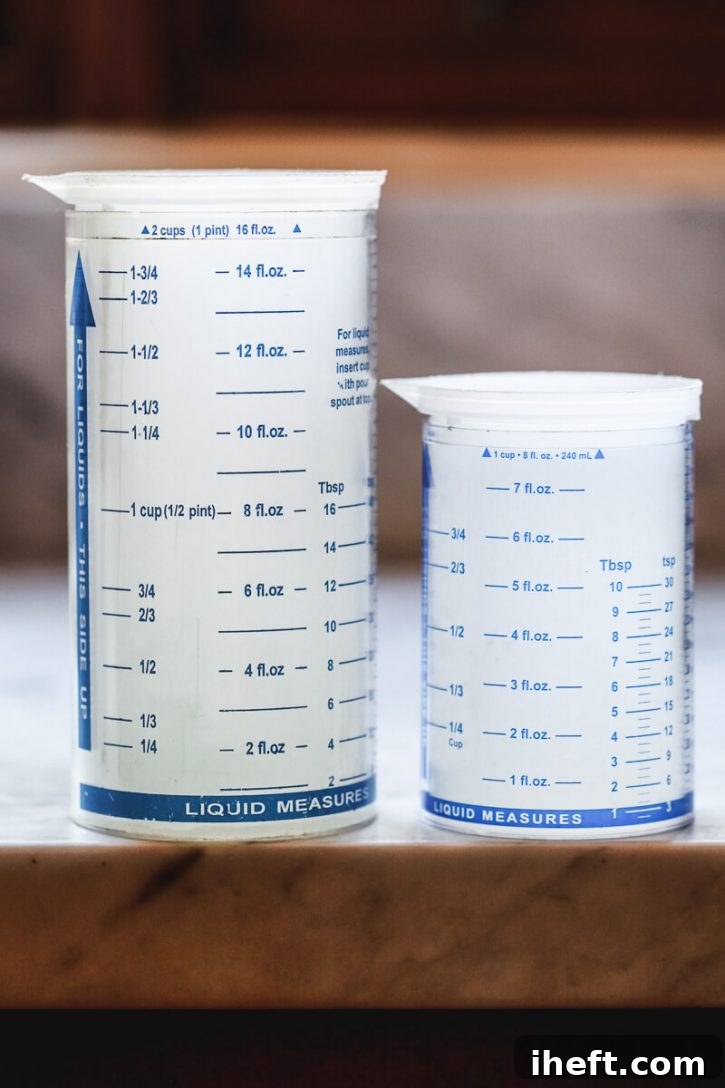
When measuring liquids, you have a choice between liquid and dry measuring cups. While dry measuring cups can technically hold liquids, liquid measuring cups are specifically designed for this purpose and offer superior accuracy and ease of use. Liquid measuring cups typically have a spout for pouring and measurement lines below the rim, which prevents spills. Since liquids naturally level themselves, you don’t need to worry about scraping off excess as you would with dry ingredients. Using a liquid measuring cup minimizes the risk of spills when transferring ingredients from the cup to your mixing bowl or pot, making the process cleaner and more efficient.
Reading the Measurement Correctly
One of the most common mistakes in liquid measurement is reading the amount from above or below eye level. To ensure accuracy, always place your liquid measuring cup on a flat, level surface and then bend down so your eyes are level with the measurement line. The liquid will form a slight curve at the top, known as a meniscus. For most home cooking, you should read the measurement at the bottom of this curve. This eye-level check eliminates parallax error, guaranteeing that you’re adding the exact amount of liquid required by your recipe.
Beyond Cups: Spoons for Smaller Measures
For smaller volumes, such as teaspoons and tablespoons, measuring spoons are your go-to tools. These are designed for both wet and dry ingredients and are crucial for spices, extracts, and other potent flavorings. For a comprehensive guide on converting and measuring these smaller units, be sure to learn about Teaspoons and Tablespoons here.
Why Precision Matters
In cooking, especially for dishes like soups and stews, a slight deviation in liquid measurement might be forgiving. However, in baking, precision is king. Too much or too little liquid can drastically alter the texture, consistency, and overall success of baked goods, leading to dry cakes or runny doughs. By consistently applying these measuring tips, you ensure that every ingredient contributes exactly as intended, leading to consistently delicious results.
Get Cooking! Use These Handy Liquid Measurement Conversions Today
Embarking on a culinary journey, especially for those new to the kitchen, can bring forth many questions, such as “How many cups in a quart, pint, or gallon?” Given the unique nature of U.S. customary measurements, even seasoned cooks can sometimes find themselves momentarily stumped. Remembering the precise number of cups in a gallon, quart, or pint can be a challenge, but it doesn’t have to be a source of frustration.
We sincerely hope that this comprehensive guide has provided you with clarity and confidence regarding liquid measurement conversions. Equipped with the knowledge of the Gallon Man and detailed breakdowns of each conversion, you’re now better prepared to tackle any recipe that comes your way. The next time you’re preparing a hearty pot of soup, concocting a refreshing drink for a gathering, or meticulously baking a cake, and your usual measuring cup is nowhere to be found, you can confidently turn to this guide. Understanding these essential relationships empowers you to adapt, scale recipes, and ensure culinary success every time.
Don’t forget to download our free printable guides, including the charming Gallon Man, to keep these vital conversions at your fingertips. They are an invaluable resource for any kitchen. If you’re inspired to explore more delicious possibilities, be sure to check out my complete collection of plant-based recipes for your next cooking adventure!