The Simple Teaspoon to Tablespoon Formula
Have you ever found yourself in the middle of a baking frenzy, only to discover that your essential measuring tablespoon is nowhere in sight? Perhaps it’s hiding in the dishwasher, or maybe half your measuring spoon set has mysteriously vanished. These common kitchen dilemmas often lead to frantic searches and pressing questions like, “How many teaspoons are in a tablespoon?” or “How many tablespoons in ¼ cup?” Understanding these fundamental kitchen conversions is not just about avoiding a minor inconvenience; it’s about ensuring the success of your culinary creations, from perfectly risen cakes to exquisitely seasoned entrees. This comprehensive guide aims to demystify kitchen measurements, providing clear answers, practical tips, and even a free printable conversion chart to keep handy.
Far from being a complex mathematical challenge, mastering basic kitchen conversions is a crucial skill for any home cook or baker. Whether you’re scaling a recipe, like halving a batch of the Best Chocolate Chip Cookies, or simply replacing a missing utensil, knowing these equivalents can be a true lifesaver. This knowledge empowers you to adapt on the fly, ensuring your dishes always turn out exactly as intended.
The seemingly simple act of converting teaspoons to tablespoons can be the difference between a culinary triumph and a kitchen catastrophe. Incorrect measurement conversions have historically plagued countless cooks worldwide, leading to dishes that taste, smell, or look entirely different from their original vision. Precision in the kitchen, especially when dealing with potent ingredients, is paramount. Before we dive into the exact numbers, let’s establish a clear understanding of the tools we’re working with.
What is the Difference Between a Teaspoon and a Tablespoon? Understanding Your Essential Tools
To accurately navigate kitchen measurements, it’s essential to understand the distinct roles and capacities of a teaspoon and a tablespoon. While both are commonly found in kitchen drawers, they serve different primary purposes and hold different volumes.
A **teaspoon** (abbreviated as ‘tsp’) is typically a smaller piece of kitchen cutlery, often associated with stirring hot beverages or adding sugar. However, in the context of cooking and baking, it transforms into a precise measuring tool. Standard teaspoons are designed to hold approximately 5 milliliters (ml) of liquid or dry ingredients. Their smaller size makes them ideal for measuring potent or finely controlled ingredients such as salt, specific spices, concentrated flavorings like vanilla extract, or leavening agents like baking powder and baking soda. Accuracy at this small scale is critical, as even minor deviations can significantly alter the balance of flavors or the chemical reactions in baking.
On the other hand, a **tablespoon** (abbreviated as ‘tbsp’) is a larger spoon primarily used for serving food or for eating dishes like soup or cereal. As a measuring tool, it holds a significantly greater volume than a teaspoon. This larger capacity makes it suitable for ingredients needed in greater quantities, such as oils, vinegars, larger amounts of spices, or thickeners like cornstarch. Understanding that these are not merely different-sized spoons but distinct units of measurement is the first step towards mastering kitchen conversions.
So, How Many Teaspoons Are in a Tablespoon? The Core Conversion
This is the question that brings most home cooks to this guide, and the answer is remarkably simple, yet profoundly important: **There are exactly 3 teaspoons in 1 tablespoon.** This fundamental conversion, representing 15 milliliters (ml), is the cornerstone of kitchen measurement accuracy. It’s a key piece of information that can save you from culinary mishaps and ensure your recipes consistently yield perfect results.
Many cooks experience anxiety over potentially ruining a dish by adding too little or too much of a critical ingredient, whether it’s salt, potent spices, or essential leavening agents. Memorizing that 3 teaspoons equal 1 tablespoon is a stress-reducing piece of knowledge that enhances your confidence and efficiency in the kitchen. While other measurement systems, like cups and quarts, often follow increments of four, the ‘three teaspoons per tablespoon’ rule is a distinct but vital one to commit to memory for smoother, more predictable cooking and baking experiences.
This simple relationship means that if your tablespoon is unavailable or dirty, you can confidently use a teaspoon three times to achieve the same measurement. Conversely, if a recipe calls for a small amount of an ingredient, and you only have a tablespoon, you know precisely how to scale down. As a baseline for larger volume conversions, remember that there are 12 teaspoons in a quarter cup, showcasing how these small units build up to larger ones.
One notable exception to this conversion rule applies specifically to herbs: **dried herbs are generally about three times as potent as fresh herbs.** So, if a recipe specifies one tablespoon of fresh thyme, and you’re substituting with dried thyme, you would only need one teaspoon of the dried variety. This proportional difference is crucial for maintaining the intended flavor balance in your dishes.
Are Measurement Units for Tablespoons and Teaspoons the Same Around the World? Navigating International Waters
While tablespoons and teaspoons are universally recognized in kitchens across the globe, their exact volumes can differ slightly depending on the regional measurement system in use. This can sometimes lead to confusion, though typically the differences for small measurements are negligible.
In the **United States**, the U.S. contemporary system defines a tablespoon as approximately half a fluid ounce, which equates to 14.79 milliliters (ml). A U.S. teaspoon, consequently, is one-sixth of a fluid ounce, or about 4.93 ml.
Contrast this with the **metric system**, which is widely adopted in many other countries. Under the metric system, a standard tablespoon is precisely 15 ml, and a teaspoon measures exactly 5 ml. Meanwhile, the **British Imperial System**, historically used in the U.K., has slightly different capacities, though it’s increasingly aligned with metric for practical cooking.
For most home cooking, these minor differences in volume (e.g., 14.79 ml vs. 15 ml for a tablespoon) are often considered negligible. When measuring small quantities of ingredients like vanilla extract or a pinch of spice, using US spoons in a metric recipe (or vice versa) is unlikely to significantly impact the final dish. However, it becomes critical to consider these differences when dealing with larger volumes. For example, a US gallon of milk is 3,785 ml, while a British imperial gallon is 4,546 ml – a substantial difference that would certainly affect recipes if not accounted for.
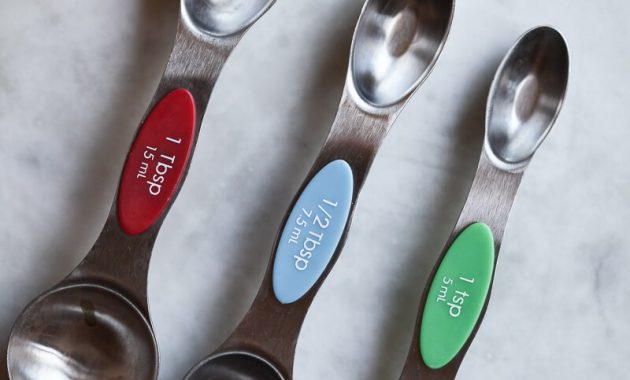
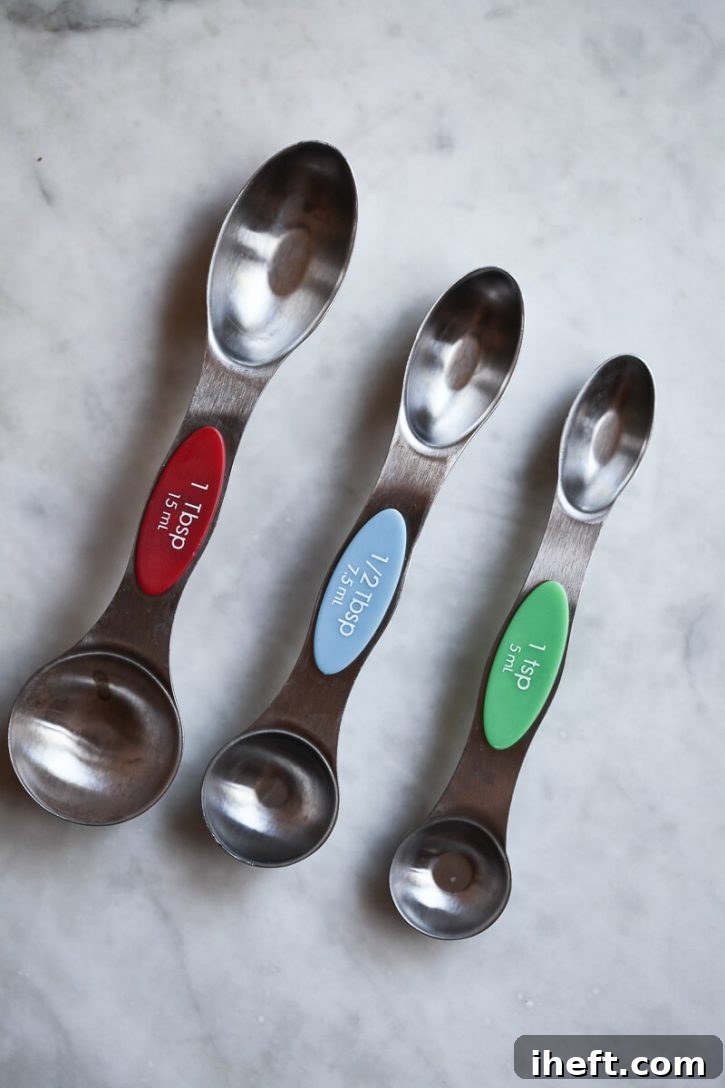
Beyond international variations, the accuracy of your measuring tools themselves can be a factor. I’ve often noticed charming measuring spoon sets sold in craft stores that, while aesthetically pleasing, are not always entirely accurate. For consistent results, invest in a reliable, high-quality set. I personally use and highly recommend a magnetic set available via my Amazon Affiliate link here (meaning I earn a small commission when you make a purchase), which offers both precision and convenience.
Essential Kitchen Conversions: Expanding Your Measurement Toolkit
Beyond the core teaspoon-to-tablespoon conversion, many other common kitchen measurements are crucial for culinary success. Let’s delve into these practical equivalents:
How Many Teaspoons Are in a Half Tablespoon?
Following the simple rule that 1 tablespoon equals 3 teaspoons, it logically follows that **there are 1 ½ teaspoons in a half tablespoon.** This conversion is frequently useful for recipes requiring very small adjustments, such as when you need to fine-tune the amount of baking powder in a delicate pastry or add just a hint of a potent spice. It’s an easy and straightforward calculation that helps maintain accuracy without requiring more specialized measuring tools.
How Many Grams in a Tablespoon? Understanding Mass vs. Volume
While we often measure using spoons, it’s important to differentiate between volume (what spoons measure) and mass or weight (what grams measure). Therefore, answering “how many grams in a tablespoon” isn’t straightforward because it **varies significantly depending on the ingredient.** For instance, a tablespoon of flour will weigh differently than a tablespoon of sugar, water, or butter due to differing densities.
As a general approximation, a tablespoon of water or a similar liquid is roughly 14 grams. However, for true accuracy when a recipe calls for grams, a **kitchen scale** is unequivocally the best tool. Scales measure mass precisely, eliminating the variability that comes with volumetric measurements of dry ingredients, which can be packed differently. For consistent baking results, especially, a kitchen scale is an invaluable investment.
How Many Milliliters (Ml) in a Tablespoon? The Metric Standard
In the metric system, which is standardized globally for scientific and many culinary applications, the conversion is precise and consistent: **There are 15 milliliters (ml) in a tablespoon.** This exact relationship makes metric measurements incredibly straightforward and is why many international recipes specify ingredients in milliliters or grams, offering superior accuracy compared to fluid ounces or cups which can vary slightly by region.
How Many Tablespoons in an Ounce? Liquid Conversions Made Easy
When dealing with liquid ingredients, converting between tablespoons and ounces is a common need. **There are 2 tablespoons in 1 fluid ounce.** This conversion is particularly handy if you’re working with a recipe that lists ounces but you only have standard measuring spoons, or vice versa. It’s also useful when you don’t have a dedicated liquid measuring cup readily available. In a pinch, even baby bottles, with their clear ounce markings, can serve as surprisingly effective tools for measuring ounces of liquid.
How Many Tablespoons in a Cup? Scaling Up Your Measurements
Moving up the scale, **there are 16 tablespoons in a standard cup.** This conversion allows you to bridge the gap between small spoon measurements and larger cup measurements. While technically feasible to measure out a full cup using just tablespoons, accuracy can be compromised when dealing with such a large number of individual measurements. For optimal precision, especially for baking, it is always recommended to use dedicated measuring cups when a recipe calls for a cup or more of an ingredient, reserving tablespoon-only conversions for smaller, more manageable quantities.
How Many Tablespoons in a Quarter Cup? A Frequent and Useful Conversion
Finally, a very common and practical conversion that you’ll likely use often is: **There are 4 tablespoons in a quarter cup (¼ cup).** This is an excellent conversion to commit to memory as it frequently comes up in recipes for dressings, sauces, or when adding smaller proportions of liquids and dry ingredients. Knowing this offhand can significantly speed up your prep time and reduce the need for constant cross-referencing.
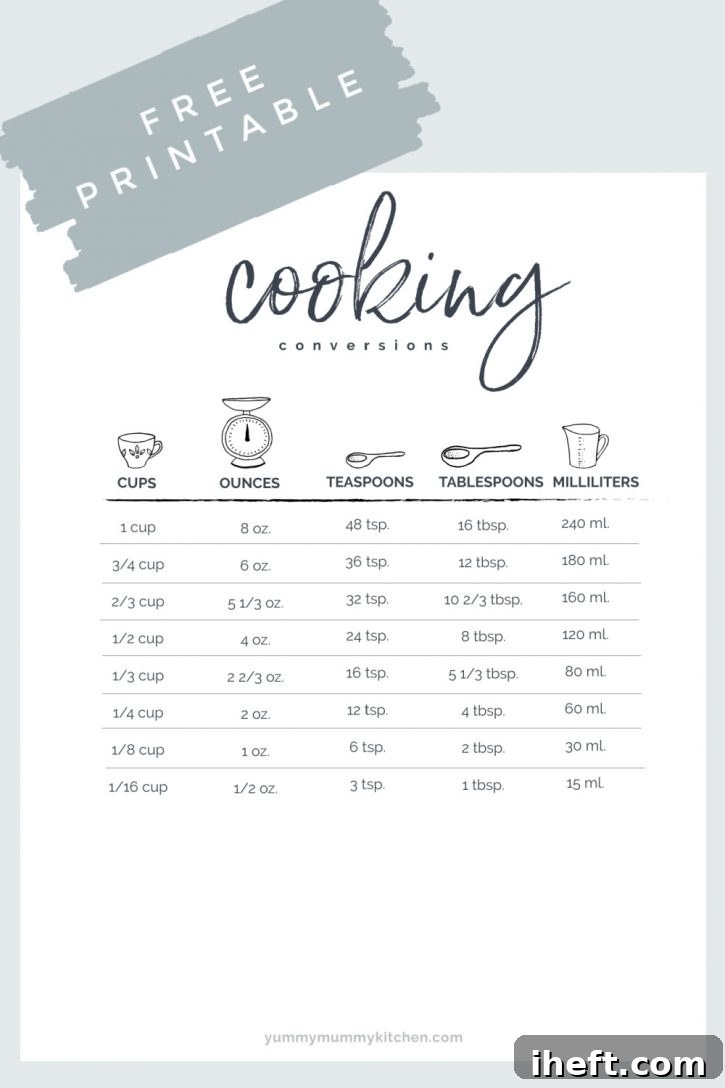
DOWNLOAD THE FREE KITCHEN CONVERSION CHART HERE!
To make your culinary journey even smoother, we’ve created a handy printable conversion chart that covers all these essential measurements and more. It’s a large image, so you may need to reduce it to 25% in your printer settings for a convenient printout to tape inside a cabinet or onto your fridge.
More Essential Kitchen Conversions & Printables
Mastering kitchen measurements extends beyond teaspoons and tablespoons. Dive deeper into other critical conversions to become a true kitchen maestro:
- How Many Ounces in a Cup: A Comprehensive Guide to Measuring Liquid and Dry Ingredients
- The Gallon Man: Effortlessly Converting Gallons, Quarts, Pints, and Cups
Mastering Kitchen Measurements: Your Path to Culinary Confidence
Navigating the world of kitchen measurements doesn’t have to be a source of stress. By understanding the core relationship between teaspoons and tablespoons, differentiating between measuring tools, and familiarizing yourself with other common conversions, you unlock a new level of culinary confidence and precision. Whether you’re a seasoned chef or a budding home cook, knowing these fundamental equivalences ensures that your ingredients are always perfectly balanced, your baked goods rise flawlessly, and your dishes consistently delight.
Embrace these simple yet powerful conversions, keep your reliable measuring tools close, and don’t hesitate to refer to our handy conversion chart. With these tips and tricks, you’ll be well-equipped to tackle any recipe, adapting with ease and creating delicious meals every time. Happy cooking!