Mastering Kitchen Measurements: Cups to Ounces for Wet and Dry Ingredients
The Ultimate Guide to Ounces in a Cup: Decoding Liquid vs. Dry Measurements for Perfect Recipes
Understanding measurement conversions is a cornerstone of successful cooking and baking, yet few topics cause as much confusion as the seemingly simple question: “How many ounces are in a cup?” This seemingly straightforward query opens a Pandora’s box of liquid ounces, dry ounces, volume, weight, and international differences. Whether you’re a seasoned chef or a beginner home cook, mastering these distinctions is essential for achieving consistent, delicious results in the kitchen.
The confusion often stems from the fact that the term “ounce” can refer to two entirely different concepts: a unit of weight or a unit of volume. When a recipe calls for a specific amount, knowing which type of measurement is implied can make all the difference between a perfect cake and a kitchen disaster. This comprehensive guide will demystify the ounces-to-cup conversion, clarify the nuances between liquid and dry measurements, and equip you with the knowledge to confidently tackle any recipe, regardless of its origin.
Why the Confusion? Understanding Ounces and Fluid Ounces
As a recipe developer, I frequently encounter comments like, “Your recipe says 6 oz. of baby spinach (about 4 cups), but that can’t be right because a cup is 8 oz!” This highlights a very common misunderstanding. The core of the confusion lies in differentiating between ounces as a measure of weight and fluid ounces as a measure of volume. While both share the name “ounce,” they describe fundamentally different properties of an ingredient.
Ounces measure weight, while fluid ounces measure volume. This distinction is paramount in the kitchen. Weight refers to how heavy something is, typically measured on a scale. Volume, on the other hand, refers to the amount of space an ingredient occupies, typically measured with a measuring cup. Think of it this way: a feather might take up a lot of space (volume), but it weighs very little. A small lead sinker takes up little space but is surprisingly heavy. This difference is why “ounces in a cup” isn’t a single, straightforward answer, but rather depends entirely on what you’re measuring.
Let’s break down these critical differences to ensure your culinary creations always turn out just right. For a broader understanding of kitchen volume, explore this post on Gallons, Quarts, Pints & Cups.
How Many Fluid Ounces in a Cup? The Liquid Standard
When most people confidently state, “There are 8 ounces in a cup!” they are almost always referring to fluid ounces. This is the standard for measuring liquids, where weight and volume are consistently related. For common liquids like water, milk, coffee, juice, or oil, the conversion is indeed simple and universally applied within the U.S. Customary system:
- There are exactly 8 fluid ounces in 1 standard U.S. cup.
This consistent relationship is why liquid ingredients are often measured by volume. A cup of water will always occupy the same amount of space and, importantly, have the same approximate weight (at room temperature) as 8 fluid ounces. This predictability makes liquid measurements relatively straightforward. You can pour 8 fluid ounces of water into a measuring cup, and it will fill up to the 1-cup mark.
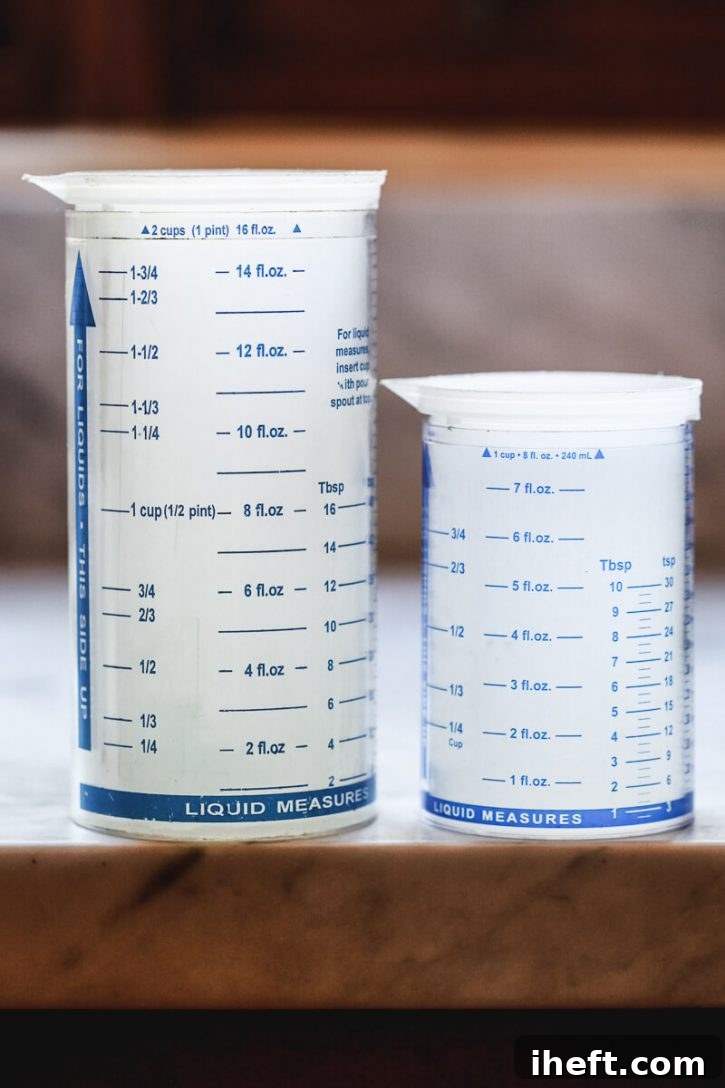
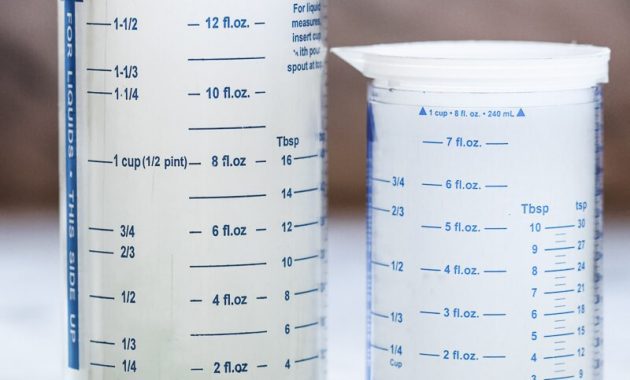
Liquid measuring cups are specifically designed for this purpose, often made of clear glass or plastic with a spout, allowing you to read the measurement at eye level without spilling. For any recipe calling for “ounces” of a liquid ingredient, you can safely assume it means fluid ounces, and the 8 fluid ounces per cup rule applies.
How Many Dry Ounces in a Cup? It’s Not So Simple!
This is where things get considerably more nuanced and where the common 8-ounce-per-cup assumption falls apart. When we talk about “a cup of flour” or “a cup of chocolate chips,” we are primarily referring to volume—how much space that ingredient takes up when scooped into a measuring cup. We are NOT referring to its weight in ounces.
The problem arises because dry ingredients have varying densities. A cup of a light, fluffy ingredient like popcorn will weigh significantly less than a cup of a dense ingredient like chocolate chips, even though they both occupy the same “volume” of one cup. This is why attempting to equate dry ounces (weight) with cups (volume) directly is misleading and can lead to inaccurate results, particularly in baking where precision is key.
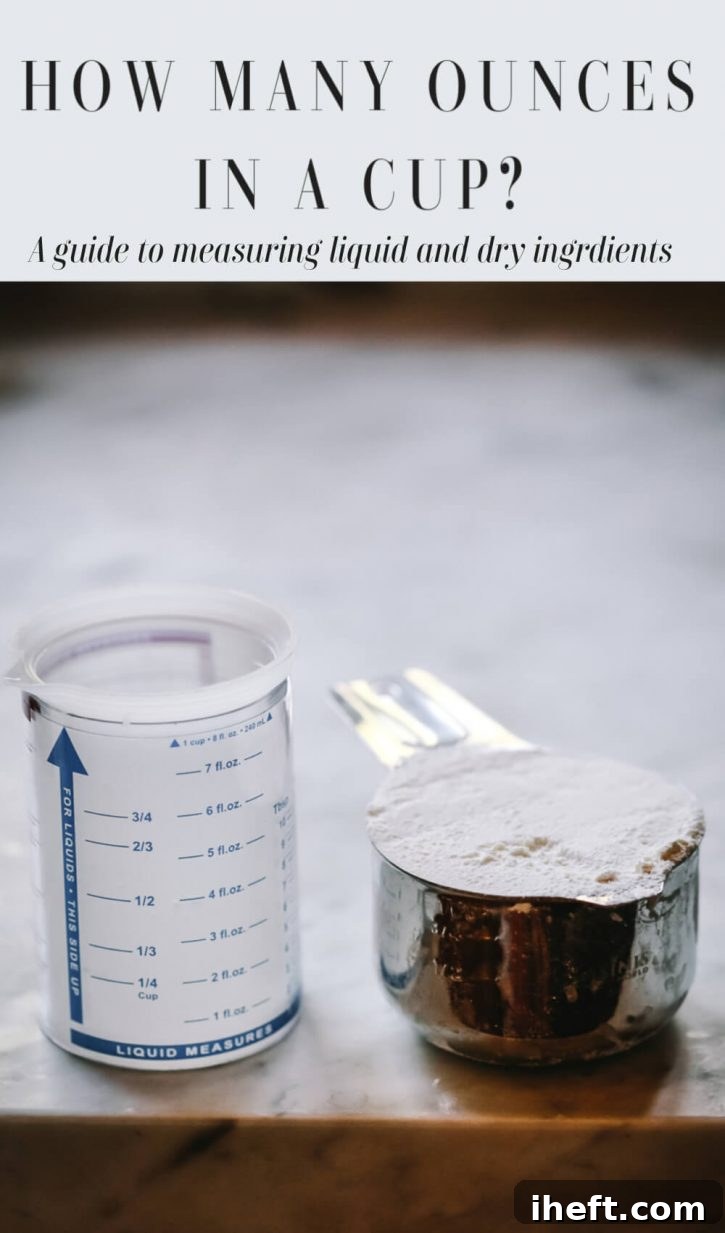
Consider the visual example provided:
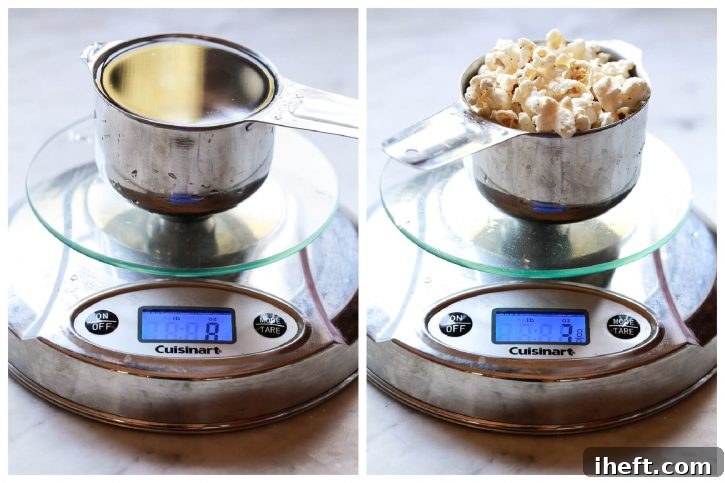
On the left, one standard U.S. measuring cup filled with water weighs approximately 8 ounces, consistent with fluid ounces. On the right, the same standard U.S. measuring cup filled with popcorn weighs only 3 ounces. This stark difference clearly illustrates that the “dry ounces” (weight) in a cup depends entirely on the specific ingredient’s density and how it’s packed.
Common Dry Ingredients: A Quick Reference
To further demonstrate this variability, here are more examples of the approximate weight (in ounces) of one standard U.S. cup for various dry ingredients:
- 1 cup of fresh parsley = approximately 1 ounce
- 1 cup of popped popcorn = approximately 3 ounces
- 1 cup of all-purpose flour = approximately 4¼ ounces
- 1 cup of chocolate chips = approximately 6 ounces
- 1 cup of shredded cheese = approximately 3 ounces
- 1 cup of granulated sugar = approximately 7 ounces
- 1 cup of brown sugar (packed) = approximately 7.5 ounces
- 1 cup of oats = approximately 3.5 ounces
You might find slight variations in these numbers across different sources, which is perfectly normal. Factors like how tightly an ingredient is packed (e.g., flour can be spooned lightly or scooped densely), the brand, or even humidity can affect its weight. For instance, brown sugar or shredded cheese can compact significantly, altering their weight per cup. King Arthur Baking Company offers an extensive list of ingredient weights in volume (cups), grams, and ounces, which can be an invaluable resource for bakers.
The Importance of a Kitchen Scale for Dry Ingredients
Given the inconsistency of dry ounces per cup, a kitchen scale becomes an indispensable tool, especially for baking. Baking is a precise science, and small errors in measuring dry ingredients by volume can significantly impact the final texture and outcome. Measuring by weight (in ounces or grams) eliminates the variables of packing density and ensures consistent results every time.
If a recipe calls for “ounces” of a solid ingredient like cheese, nuts, or chocolate that isn’t already specified as “fluid ounces,” it almost certainly refers to weight. In such cases, it’s often best to refer to the product packaging. For example, if you have an 8-ounce block of cheese and the recipe calls for 2 ounces, you would simply cut off a quarter of the block. If you need to grate that cheese, remember that grating will increase its volume. For instance, a 6-ounce block of cheese might yield about a cup or more of grated cheese. Always keep these transformations in mind when converting between block weight and grated volume.
Navigating Global Kitchens: US, UK, and Metric Cups
To add another layer of complexity, measurement units can vary significantly depending on the country where a recipe originated. What constitutes “a cup” or “an ounce” in one region may be different in another. This is particularly relevant when using international cookbooks or online recipes.
The primary systems in use are the U.S. Customary system, the British Imperial system, and the Metric system (used by most of the rest of the world). Understanding these differences is crucial for accurate conversions and successful recipe execution.
Cup Size Differences
The volume of “one cup” is not uniform across all systems:
- 1 U.S. Customary cup is approximately 236.59 milliliters (often rounded to 240 ml for culinary purposes).
- 1 British Imperial cup (historically used in the UK, though now largely metric) is 284.13 milliliters (often rounded to 280 ml).
- 1 Metric cup (used in Australia, Canada, New Zealand, etc.) is exactly 250 ml.
As you can see, these differences, while seemingly small, can accumulate, especially in recipes requiring large quantities or precise ratios, like baking. For simple recipes, the variance might be negligible, but for delicate pastries or complex formulas, using the correct cup size can be critical. When in doubt, try to identify the recipe’s origin and use measuring cups from that region, or convert accurately. To convert 1 U.S. cup to 1 UK Imperial cup, you’d add approximately 1½ tablespoons (22-25 ml).
Fluid Ounce Variations Internationally
Just as cup sizes differ, so do fluid ounces:
- 1 U.S. fluid ounce is approximately 29.57 milliliters (often rounded to 29.6 ml).
- 1 British Imperial fluid ounce is exactly 28.41 milliliters.
Again, these are subtle differences, but they reinforce the importance of being aware of the measurement system a recipe is using. When following a recipe, always try to use the measuring tools appropriate to the recipe’s geographical origin to minimize potential discrepancies.
The Right Tool for the Job: Liquid vs. Dry Measuring Cups
While both liquid and dry measuring cups are designed to hold a specific volume, their designs cater to optimal accuracy for their intended purpose. While you *can* technically use them interchangeably, using the correct type of cup for the ingredient will yield the best and most precise results.
- Liquid Measuring Cups: These are typically clear glass or plastic, featuring a spout and measurement lines marked on the side. Their design allows you to fill to the exact line and read the measurement at eye level, preventing spillage and ensuring accuracy for liquids like water, milk, or oil. The extra space above the highest marking (the “headspace”) prevents liquids from sloshing over the edge.
- Dry Measuring Cups: These usually come in sets (e.g., ¼ cup, ⅓ cup, ½ cup, 1 cup) and are often made of metal or plastic. They are designed to be filled to the brim and then leveled off with a straight edge (like a knife or the back of a spoon). This “leveling” technique removes any excess, ensuring an accurate measure of ingredients like flour, sugar, or chopped vegetables. If you were to use a liquid measuring cup for dry ingredients, it would be much harder to level off precisely.
For ultimate accuracy in the kitchen, especially for baking, I highly recommend owning both a set of dry measuring cups and at least one liquid measuring cup. Furthermore, as discussed, a digital kitchen scale is invaluable for recipes that specify weights (in grams or ounces), particularly those from European cuisines or baking where precision is paramount.
Essential Kitchen Conversions for Everyday Cooking
Beyond the core discussion of ounces and cups, several other common conversions are helpful to have at your fingertips. Understanding these relationships can streamline your cooking process and help you adapt recipes more easily.
How Many Ounces in a Quarter Cup?
Applying our established rule for liquids, if there are 8 fluid ounces in a full cup, then calculating for a quarter cup is straightforward:
- There are 2 fluid ounces in a quarter cup (1/4 cup).
This conversion is most useful when measuring small amounts of liquid ingredients, allowing for quick mental math or precise pouring.
How Many Ounces in a Gallon?
Scaling up, a gallon contains a significant number of fluid ounces. Knowing this conversion is useful for larger liquid quantities:
- There are 128 fluid ounces in one U.S. gallon.
To put this into perspective, a typical shot glass holds around 1.5 to 2 fluid ounces. We’ll soon be providing free printable charts to make conversions between cups, pints, quarts, and gallons even easier to reference.
More Helpful Kitchen Conversions to Know
Mastering these fundamental conversions will empower you to tackle any recipe with confidence:
- Teaspoons to Tablespoons: A crucial conversion for smaller quantities.
- Cups, Pints, Quarts, and Gallons: Understanding the hierarchy of liquid volume measurements.
- Grams to Ounces: Essential for converting metric recipes to U.S. Customary weights.
- Fahrenheit to Celsius: For oven temperatures, especially when following international recipes.
Master Your Measurements: Key Takeaways
Navigating the world of kitchen measurements doesn’t have to be daunting. By remembering a few key principles, you can approach any recipe with confidence:
- Liquid vs. Dry: Always distinguish between liquid (fluid ounces, volume) and dry (weight in ounces or volume in cups) measurements.
- The 8-Ounce Rule: This applies consistently to fluid ounces in a U.S. cup for liquids.
- Dry Varies: The weight of dry ingredients per cup varies greatly due to density and compaction.
- Invest in Tools: Own both liquid and dry measuring cups, and seriously consider a digital kitchen scale for accuracy, especially in baking.
- Check Your Origin: Be mindful of whether a recipe uses U.S., UK, or Metric measurements, and adjust your tools or conversions accordingly.
With this knowledge, you’re well-equipped to measure ingredients accurately, understand why certain conversions matter more than others, and ultimately, achieve consistently delicious results in all your culinary adventures. Happy cooking!
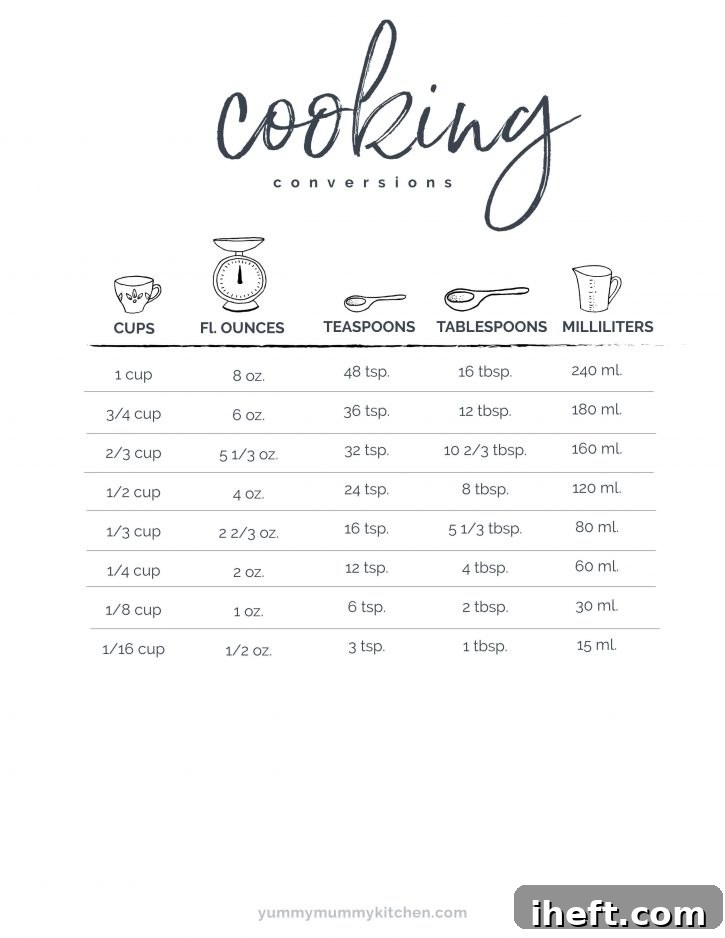
CLICK HERE TO DOWNLOAD YOUR FREE PRINTABLE KITCHEN CONVERSION CHART